John Dee's First Question to the Angels — Finally Answered
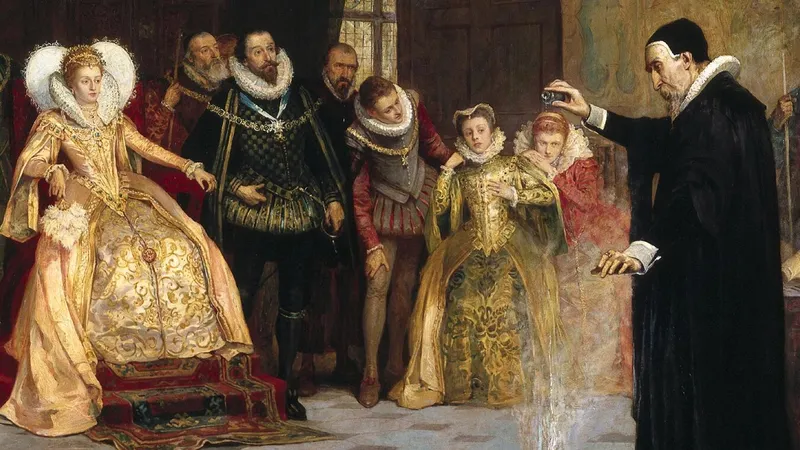
March 10, 1582, old style. A new scryer has just arrived at John Dee's house in Mortlake, a man named Edward Kelley, going by Talbot at the time. This is their first session together, the beginning of the partnership that will produce the Enochian Calls, the Watchtowers, and Loagaeth.
The first thing John Dee asks the archangel Uriel is this: "Ys my boke, of Soyga, of any excellency?... Oh, my great and long desyre hath byn to be hable to read those tables of Soyga."
With the heavens finally open, the most learned man in Elizabethan England asks for help reading a book he already owns. Uriel answers that the book is good, revealed to Adam in paradise, but that only the archangel Michael can interpret its tables.
Dee worked the angelic system for the rest of his life. He never got the interpretation, and the question stayed open for four hundred and forty-four years.
The Book That Was Never Lost
The flyer for my June 13 workshop said the Book of Soyga "disappeared in 1608 and remained lost until 1994." That was my version too, and one of the first things this investigation did was correct its own marketing. In fact the book sat catalogued in plain sight the whole time, under its other title, Aldaraia: one copy at the British Library as Sloane MS 8, one at Oxford as Bodleian MS. Bodley 908. Scholars walked past both for centuries while looking for a book called Soyga. In 1994 the historian Deborah Harkness made the identification: Aldaraia is the Book of Soyga, two surviving witnesses of a lost original.
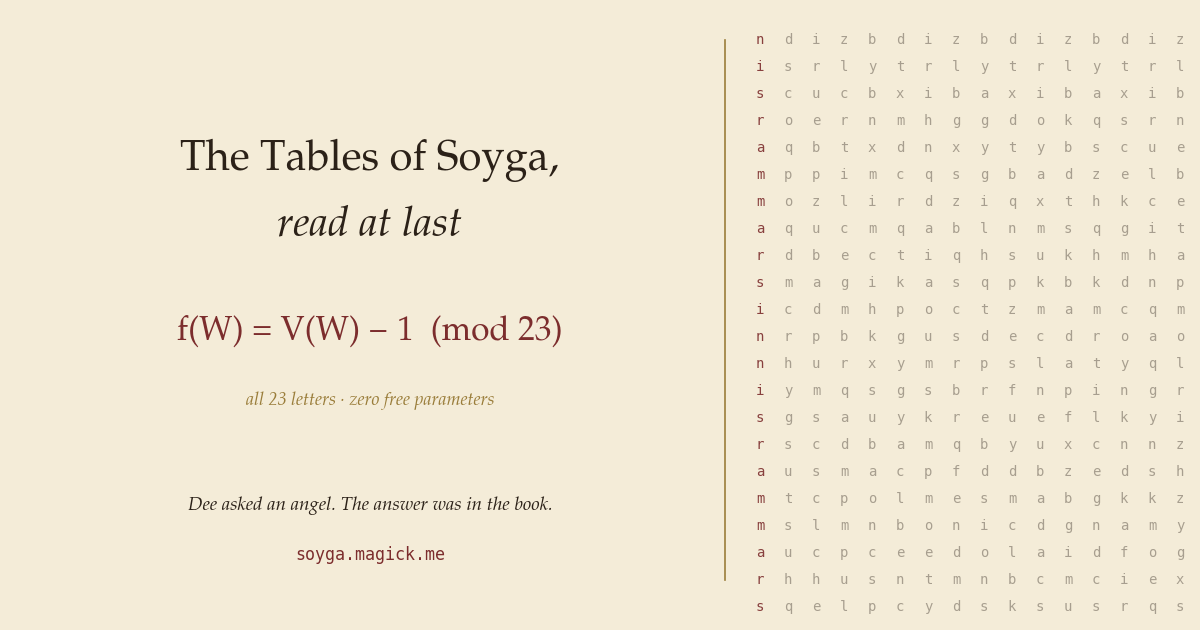
That identification set up the second breakthrough. In 1998 (published 2006) the cryptographer Jim Reeds proved the tables are generated algorithmically. Every table grows from a six-letter seed word, and every cell follows the rule X = N + f(W) mod 23, where N is the letter above and W the letter to the left, counted through a twenty-three-letter alphabet with no j, v, or w. Reeds verified this across all forty-six thousand six hundred fifty-six cells. The tables of a sixteenth-century magical manuscript turn out to be procedurally generated.
Reeds also left one hole, and said so plainly. The auxiliary function f, the amount you advance for each letter, he could determine only empirically. In his words it was "known to us only by a table of values determined empirically." Why does e advance fourteen? Why does m advance twenty-two? Nobody knew, and the hole sat open for twenty-six years.
The Answer Was Printed in the Book
The finding, stated narrowly: the origin of Reeds's function is the book's own letter-value system, set out in verse in Section 18 of its prose.
f(W) = V(W) − 1 (mod 23)
V is the numerical value the Book of Soyga assigns to each letter of its alphabet. Reeds's function is that system, off by one, and the off-by-one is simply the difference between counting a letter inclusively and counting the steps past it.
Section 18 opens with "Versibus ostendam quid monstret quaeque figura": in verses I will show what each figure denotes. Then it does, line by line, for all twenty-three letters. Three for z, b, a, and f. Seven for g. Nine for o, t, and s. Fifteen for e, n, and i. The strangest line, "Vigintique novem D dat cum sumitur ampla," gives d a value of twenty-nine, larger than the alphabet itself.
Subtract one from each value and reduce mod twenty-three, and you have Reeds's empirical function exactly: twenty-three letters, twenty-three matches, one uniform constant, zero free parameters.
The two halves of the answer sat in the same codex for four and a half centuries. Reeds analyzed the grids while the prose held the key; he even noted in passing that the book "assigns numerical values to letters," and never connected them to f. The full prose wasn't transcribed until Jane Kupin's 2014 edition. What's new here is the connection between Section 18 and Reeds's function.
The Verse Is Not an Island
That d = 29 looks like a transcription error. It isn't, because the same value does work elsewhere in the book. Section 9 says porta paradis, the gate of paradise, sums to 132, which only happens if d equals twenty-nine; the strange value is forced from an independent direction. Section 2 computes PATER CREATOR = 140, and it checks letter by letter. These values run arithmetic throughout the text. Fitting one verse to Reeds's table is a conceivable worry. Fitting the book's entire working arithmetic to it is not.
What the Tables Are For
Dee asked to read the tables, and the book's own answer turns out to be that reading is the wrong operation. Section 26.1 says the table "vicem speculi gerit," it holds the office of a mirror, and will make the gazer see what he wishes. Section 27 describes a grid for binding spirits, each letter summoning a numbered company, bound per Agla virtutem, by the power of the divine name AGLA.
We also scanned all forty-six thousand cells for hidden text, along the standard traversals (rows, columns, diagonals, broken diagonals, snake-paths, spirals, in both directions) against a seventy-thousand-word dictionary. Words appear at chance level and entropy sits at the random baseline. Within that scope there is no hidden message and there was never a plaintext to find. The tables are a scrying ground and a binding grid, instruments to use rather than text to decode, which casts Uriel's deferral in a different light.
How This Was Done
AI-assisted and human-directed, disclosed plainly, because the methodology is the credibility. Every arithmetic claim was run in code rather than asserted from memory, and every quote was read at its line number in the primary source. The work then went through seven adversarial review passes, including a blinded replication in which a reviewer was given only Reeds's function and the raw text of Kupin's edition, with no access to this work, and rediscovered the verse and the identity independently. Five corrections to our own early figures are published in the audit trail, and the verification code is public at soyga.magick.me.
What I Am Not Claiming
The claim is specific: the source of Reeds's auxiliary function f is the letter-value system of Section 18, exact for all twenty-three letters. I am not claiming the tables are "solved" in any grand sense. The seed-word recipe is only partly recovered, and the Moon table's row waits on undigitized folios (BL Sloane MS 8, fols. 140r–141r; Bodl. 908, fols. 168v–169r). The meaning of Soyga alca miketh remains open. Whether Soyga's thirty-six tables consciously seeded Loagaeth's forty-nine is undecidable from any text we have. And the headline rests on the printed edition until a paleographer checks the manuscript, an invitation I am actively extending.
What You Can Do Right Now
Come to the June 13 workshop in Austin. Over three hours you will generate a table from your own six-letter word, by hand, and check it against a four-hundred-year-old manuscript. No prior knowledge is needed; the only claim made of you is "bring a pencil." Details and registration: magick.me/arcane.
Read the full write-up at soyga.magick.me: the complete derivation, the verification table, the arithmetic cross-checks, the code, and the methodology, all public under CC BY 4.0.
And if you are a paleographer, or know anyone at the British Library or the Bodleian, write to jason@ultraculture.org. I need eyes on those folios, and I will buy the drinks.
John Dee asked an angel for permission to read these tables. The book had already told him everything: how to build them, what they're worth, and what to do with them. It just never occurred to anyone that the answer would be math.
He wanted Michael. What it took was a pencil.
The full derivation, verification code, and methodology are at soyga.magick.me. DOI: 10.5281/zenodo.20635591. The June 13 Austin workshop is open to all (register here); the November 2026 scholarly presentation, with the full confidence ledger, is at Enochiacon, Austin.